Arrakis, popularly known as Dune, is the name of the titular planet in the world-famous science fiction novel and film of the same name. Let’s embark on an adventure to decipher how the exotic forms of life work and look for biological analogues in the most unlikely places on Earth.
Arrakis is a single never-ending desert, unlike any place in the universe. The planet is as arid as Mars' surface in terms of precipitation in comparison, our planet is brimming with water. On Earth, the closest environment we have to Arrakis is the deserts, creatures have evolved and developed a plethora of techniques to cope with the extreme heat on Earth, however many of these adaptations will be useless on Arrakis as it has a harsher environment in comparison to Earth.
In the film, a jumping desert rat is shown hopping around the sands. In the book, after Paul Atreides was accepted into the Fremen, he inquired about the name of the leaping mouse, to which Stilgar, the Fremen's mediator, responds that it is called the Muad'Dib. It is associated with a design visible on the planet's second moon in Fremen's earth-spirit mythology. It is respected by Fremen for its capacity to survive in the open desert. In a quote from Stilgar, he says "Muad'Dib is wise in the ways of the desert. Muad'Dib creates his water. Muad'Dib hides from the sun and travels in the cool night. Muad'Dib is fruitful and multiplies over the land. Muad'Dib we call 'instructor-of-boys.' That is a powerful base on which to build your life, Paul-Muad'Dib". The Jerboa is the organism that comes closest to the Muad'Dib on Earth.
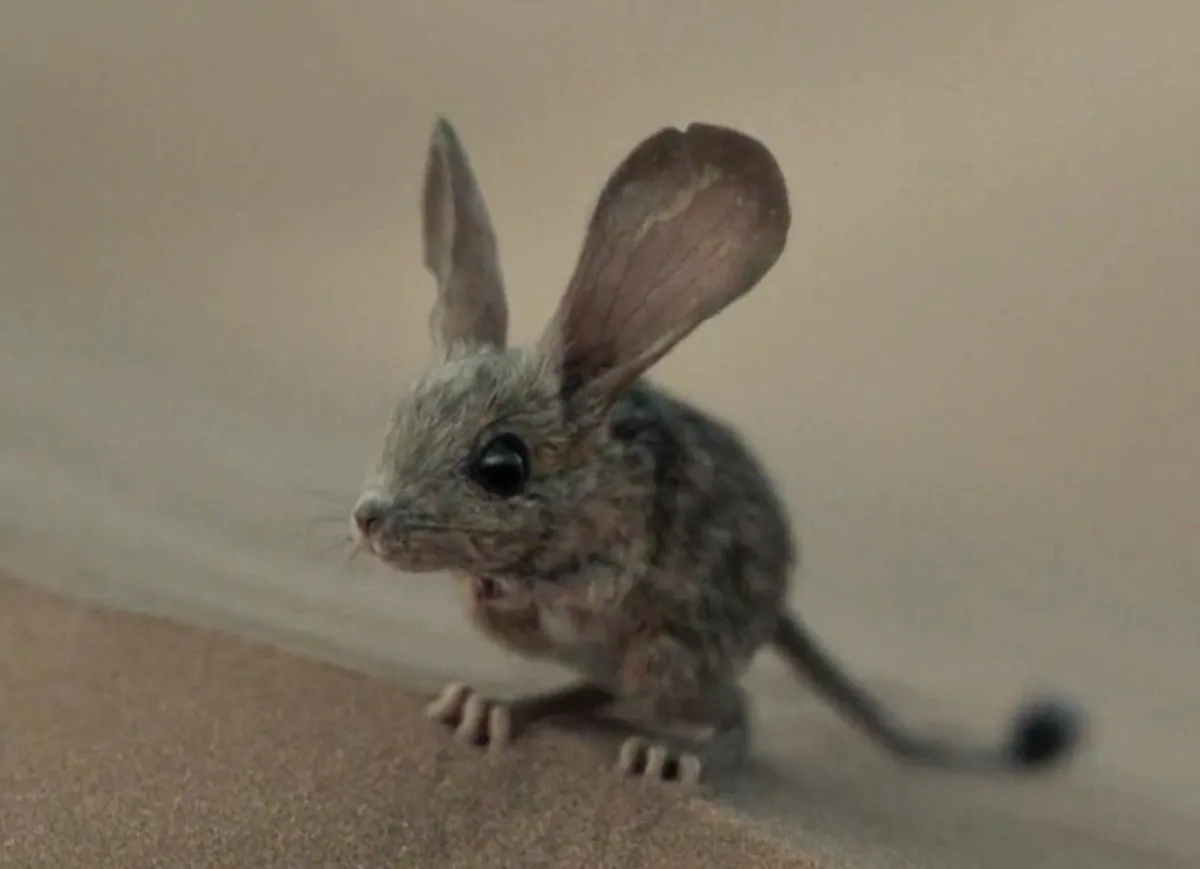
Muad’Dib

This fantastic behaviour, known as 'fog-basking,' necessitates the beetle to remain still in this position for long periods, allowing the gathered water to drip down into their mouths. As a result, the Arrakis's Muad'Dib rodent's ears are believed to have similar hydrophilic zones to aid in the gathering of water from the atmosphere.
The mouse adapting to its new environment causes this change in Muas'Dib's ear.
An adaptation is a heritable trait that helps any organism survive and reproduce in its environment. Epigenetics can explain this phenomenon.
Epigenetics studies how behaviours and environment can influence the functioning of the genes. Epigenetic alterations, unlike genetic changes, are reversible and do not alter your DNA sequence; nevertheless, they can alter how your body interprets a DNA sequence. Epigenetic alterations have a variety of effects on gene expression. Epigenetics is vital to adapt to the surrounding environment; it can help them evolve themselves to best suit the environment around them.
“All living things must grow, or they will die. Adaptation to change is a characteristic of all living systems. Thus, all living things must grow, adapt, evolve, or die. Evolution is nature’s creative way of pushing living organisms to higher degrees of complexity. We adapt up, not compromise down.”-Alvin Conway
Centers for Disease Control and Prevention. (2022, May 18). What is epigenetics? Centers for Disease Control and Prevention. Retrieved May 20, 2022, from https://www.cdc.gov/genomics/disease/epigenetics.htm
Could this desert beetle help humans harvest water from Thin Air? (n.d.). Retrieved May 20, 2022, from https://www.science.org/content/article/could-desert-beetle-help-humans-harvest-water-thin-air
Comments
Post a Comment